Why Prisons Take Over Paranormal Television
Most locations on this map are haunted by implication. A prison is haunted by paperwork. These places kept registers, punishment logs, hospital records and execution warrants, which means the deaths behind the stories usually have names and dates attached, and the rooms where those deaths happened are often still standing with the hardware intact. Add the architecture, long galleries of steel and stone that carry every sound, and it is easy to see why television crews keep coming back. The ten below run from a Quaker experiment in enforced silence that opened in 1829 to a Texas prison farm that shut down in 2011. The numbers are stops on a route through the map, not a ranking. Every heading opens that prison's card on the map, with its description, coordinates and episode list.

Eastern State Penitentiary
📍 Fairmount, Philadelphia, PennsylvaniaEastern State opened in 1829 and ran until 1971, and for most of the 19th century it was the most imitated building in the prison world. John Haviland laid it out like a wagon wheel, with cellblocks radiating from a central rotunda so a single guard could look down every corridor at once. At completion it was the largest and most expensive public structure in the country, and more than 300 prisons worldwide were built on its plan.
What made it famous was the regime, not the floor plan. The Pennsylvania system held each man alone in his own cell with his own small exercise yard, a skylight overhead and no human contact, on the theory that silence would produce reflection and reflection would produce reform. Charles Dickens walked the cellblocks in 1842 and came away convinced the opposite was happening, writing that the slow daily work on a man's mind was worse than any punishment of the body. The separate system eventually broke down under overcrowding, and by the 20th century Eastern State was a conventional and badly overstuffed prison. Al Capone served roughly eight months there in 1929 and 1930. Willie Sutton was one of twelve men who got out through a tunnel in 1945.
It has been empty since 1971 and preserved as a stabilized ruin since the 1990s, which is why it photographs the way it does. On the map it is flagged as one of the most investigated prisons in paranormal television history, with reported apparitions in the cellblocks and a long-running story about Capone being followed by something in his cell.
On television
Ghost Hunters got there first, in the show's first season in 2004. Ghost Adventures followed in 2009, five years later, in its second season.
📍 See Eastern State on the map
Moundsville Penitentiary
📍 West Virginia Penitentiary, Moundsville, West VirginiaThe West Virginia Penitentiary operated from 1866 to 1995, which is almost 130 years in one set of walls. Inmates quarried and cut the sandstone themselves, and the result looks less like a prison than a castle someone dropped on a small Ohio River town: battlements, turrets, a gatehouse. It sits directly across the street from the Grave Creek Mound, a conical burial mound raised by the Adena culture more than two thousand years ago and one of the largest of its kind in the country. The town is named for it. There are not many places in America where a 60-foot prehistoric grave and a Gothic penitentiary face each other across a two-lane road.
West Virginia carried out its executions inside these walls, first on a gallows and later in an electric chair, until the state abolished capital punishment in 1965. The building had other problems. Cells measured about five feet by seven and held two men; in the 1980s the state Supreme Court found that arrangement to be cruel and unusual punishment, and the prison was emptied for good a decade later. A riot on New Year's Day 1986 put the place on national news, with inmates holding part of the prison and taking hostages before it was brought back under control.
The map entry notes shadow figures, EVPs of voices in distress, and residual activity connected to the executions.
On television
The Moundsville episode of Ghost Adventures aired on Halloween night in 2008, the third of its first season, back when the whole format was three men locked in a building until sunrise. Ghost Hunters had covered the prison two years earlier, in a 2006 episode titled "Shadow People."
📍 See Moundsville on the map
Missouri State Penitentiary
📍 Jefferson City, MissouriThis one opened in 1836, when Missouri was fourteen years a state, and did not close until 2004. By then it was the oldest working prison west of the Mississippi. Time magazine called it the bloodiest 47 acres in America, and the name stuck. A 1954 riot left inmates dead and much of the prison burning. The gas chamber in the yard was used from the late 1930s onward.
Two names carry the place in public memory. Sonny Liston learned to box in the prison gym while serving time for armed robbery, and went from there to the heavyweight championship. James Earl Ray escaped in 1967, hidden in a bread truck, and was still a fugitive when he shot Martin Luther King Jr. the following April. The prison that could not hold him is this one.
The state replaced it with the Jefferson City Correctional Center in 2004 and left the old cell houses standing. The map logs violent apparitions and EVPs tied to executed prisoners, mostly in the decaying blocks that have not been restored.
On television
Ghost Adventures filmed inside the cell houses and halls in 2013, leaning on the prison's reputation for violence rather than on any single ghost story. Ghost Hunters had been there first, in a 2011 episode titled "The Bloodiest 47 Acres."
📍 See Missouri State Penitentiary on the map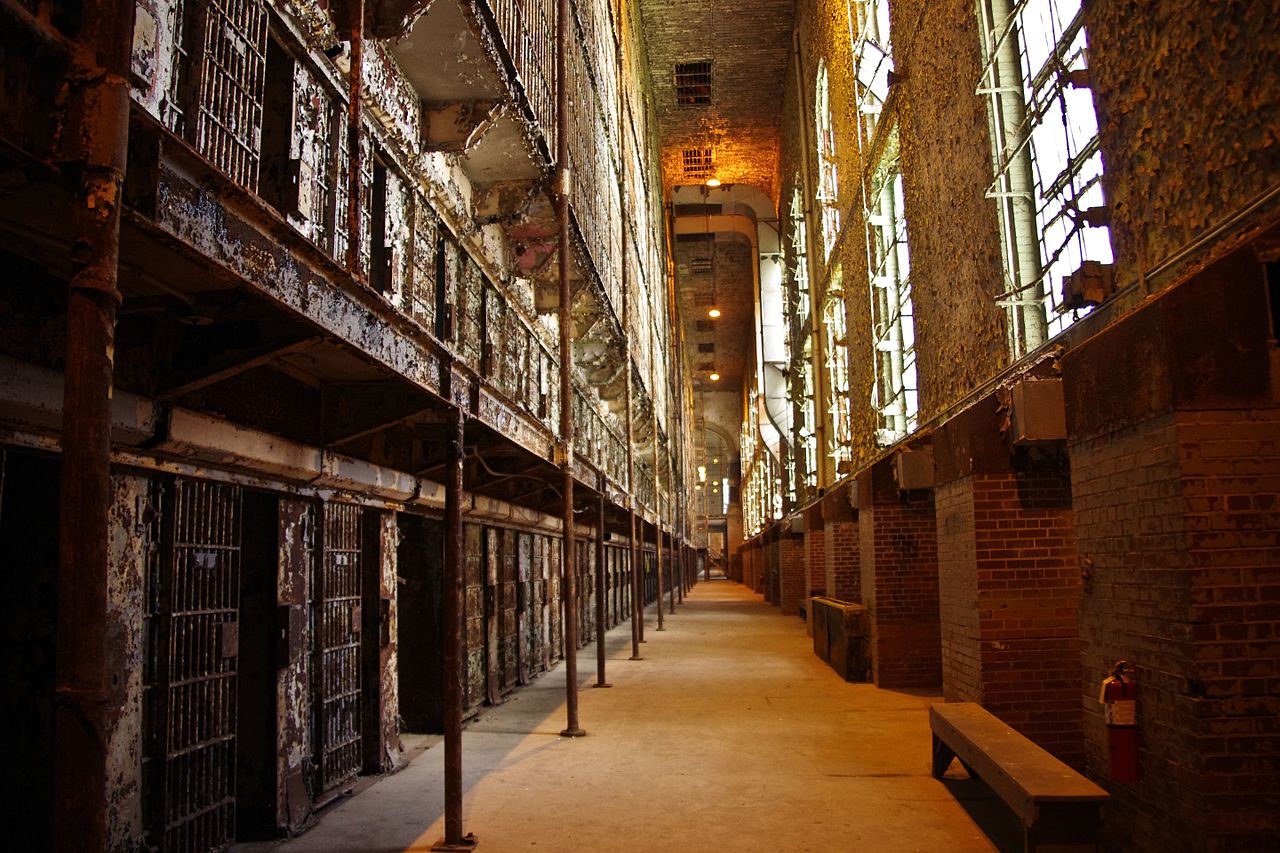
Ohio State Reformatory
📍 Mansfield, OhioLevi Scofield designed the reformatory to look like a cathedral, on the theory that young men sent there would be moved toward reform by the architecture. Construction ran from 1886 to 1910, the first inmates arrived in 1896 while the work was still going on, and the institution stayed open until 1990, when a federal court ruling ordered it closed. Inside that Romanesque shell sits a six-tier cell block, the largest free-standing steel cell block ever built, 600 feet of stacked cages under a skylight.
It is also the most recognizable prison in American film. The Shawshank Redemption used it for most of its 1994 shoot, and the administration wing, the cell block and the yard turn up in a long list of other productions. The map's entry records more than 200 documented deaths on the property across its working life, with the heaviest reported activity in the solitary confinement block and the administration wing, where a superintendent's wife and later the superintendent himself died in the 1950s.
On television
Ghost Adventures covered it in 2009, in a season-three episode that leans on the sheer scale of the place and the more than 150,000 inmates who passed through it. Ghost Asylum followed in 2015.
📍 See the Ohio State Reformatory on the map
Old Montana State Prison
📍 Deer Lodge, Powell County, MontanaMontana was still a territory in 1871 when this prison took its first inmates, and it stayed the state's main penal institution until 1979. The walls and most of the buildings were put up by the prisoners themselves under warden Frank Conley, who ran the place from 1890 to 1921 and kept inmates working on everything from the cell houses to state road crews. After Conley left, the prison spent nearly forty years sliding into overcrowding and disrepair.
That ended in April 1959, when Jerry Myles and Lee Smart led a takeover that held the prison for 36 hours. A deputy warden was shot and killed. The Montana National Guard stormed the walls to end it, and both men who led the riot were dead before the smoke cleared. The state built a new facility a few miles west of town in the 1970s and moved everyone out in September 1979, leaving the old prison on the National Register and intact enough to film in.
Phantom Finder's entry calls it one of Montana's most-investigated paranormal sites, with reports of camera and battery failures, choking sensations, and residual activity through the cell blocks and the solitary tunnels.
On television
Ghost Lab investigated the prison for an episode titled "No Escape" in 2010. Ghost Adventures followed in 2015.
📍 See Old Montana State Prison on the map
Wyoming Frontier Prison
📍 Rawlins, Carbon County, WyomingWyoming started building its first state penitentiary in Rawlins in 1888 and then spent thirteen years failing to finish it, through funding gaps and brutal high-desert winters. The first inmates arrived in December 1901, into a building with no running water and no electricity. It stayed in use for eighty years, until the state opened a replacement elsewhere in Rawlins in 1981, and locals have called it the Old Pen ever since.
Executions were carried out on site, first by hanging and later in a gas chamber, and the death house is still there. Men also died from the conditions: Wyoming winters in an unheated stone cell block, punishment cells, and the ordinary violence of a prison that was chronically short of money and staff. Reports on the map describe aggressive shadow figures, cell doors slamming on their own, and residual activity tied to both the executions and the day-to-day brutality.
On television
Ghost Adventures' Old Pen episode aired in January 2013.
📍 See the Wyoming Frontier Prison on the map
Yuma Territorial Prison
📍 Yuma, ArizonaThe Arizona Territory opened this prison on July 1, 1876 and closed it on September 15, 1909. In those 33 years, 3,069 prisoners served sentences there, including 29 women, for everything from murder to polygamy. The inmates built and rebuilt the place themselves, raising adobe and stone cells on the bluff above the Colorado River, and the heat did the rest. Summer temperatures in Yuma run well past 100 degrees for months, and the cells held six men each on iron bunks with almost no ventilation.
The dark cell was a chamber blasted into the hillside with a single grated shaft for air and light. It was used for solitary confinement, in that climate. The prison also had electricity, a library and ventilation fans before much of the town did, which is why critics of the day sneered that it was a country club on the Colorado. The graveyard outside the walls holds 104 of the men who died while serving their sentences, most of them from tuberculosis. After the prison closed, the local high school used the buildings for four years while its own was rebuilt.
The map keeps the nickname the paranormal shows use, the Hell Hole, and lists shadow figures, EVPs of crying, and the heaviest activity in the cells and the dark cell.
On television
Ghost Adventures investigated Yuma in 2016 for an episode titled "Hell Hole Prison," working the main cell block and the solitary chamber.
📍 See Yuma Territorial Prison on the map
Alcatraz Island
📍 Alcatraz Island, San Francisco Bay, CaliforniaThere has been a fort on this rock since the 1850s. The cellhouse that everyone pictures was built between 1910 and 1912 as a U.S. Army prison, and the Justice Department took the island over in 1933 and reopened it in August 1934 as a federal penitentiary for men other prisons could not hold. It ran for 29 years on a simple premise: cold water, hard currents, 1.25 miles of bay, and nowhere to go. Cells were nine feet by five. D Block held the isolation unit, with six cells at the far end known as the Hole.
Two events define the place. In May 1946, an escape attempt led by Bernard Coy turned into a two-day siege now called the Battle of Alcatraz; two officers and three inmates were killed, and two of the surviving prisoners were executed in 1948. In June 1962, Frank Morris and brothers John and Clarence Anglin got out through the ventilation system on a raft made of raincoats and were never found. The prison closed in March 1963 because it cost far more to run than any facility on the mainland, and from 1969 to 1971 the island was occupied by Native American activists. The National Park Service runs it now.
The map's notes report phantom footsteps, cell doors slamming, and apparitions in Cellblock D, the isolation wing.
On television
Ghost Hunters ran a live event from the island in 2010 to open its sixth season. Ghost Adventures followed with its own investigation of the cellhouse in 2013.
📍 See Alcatraz on the map
Nevada State Prison
📍 Carson City, NevadaNevada's state prison started in 1862 inside a hotel. Abraham Curry, one of the founders of Carson City, leased his Warm Springs Hotel to the territory, and the sandstone quarry on the property supplied the stone for the walls that went up around it, along with much of the state capitol. The prison ran continuously for 150 years and closed on May 18, 2012, one of the oldest working prisons in the country at the end.
Its place in history is grimmer than its origins. In the early 20th century Nevada made this the state's only execution site, and on February 8, 1924 it carried out the first execution by lethal gas anywhere in the world, on a prisoner named Gee Jon. The state had planned to pump the gas into his cell and had to improvise a sealed chamber when that proved impossible.
Accounts on the map describe shadow figures, EVPs and residual hauntings in the cell blocks, with the execution history doing most of the work behind the reports.
On television
Ghost Adventures investigated in 2016, a few years after the last inmates were moved out, when the building was empty but still fully fitted.
📍 See Nevada State Prison on the map
Central Unit Prison, Sugar Land
📍 Sugar Land, Fort Bend County, TexasTexas opened the Imperial State Prison Farm in April 1909 on about 326 acres of former sugar plantation land outside Houston, and worked inmates in the cane and the fields the way the plantation had worked the people before them. The name changed to the Central Unit, Sugar Land grew into an affluent suburb around it, and by the end the prison was a walled farm sitting inside a city of master-planned neighborhoods. In August 2011 Texas closed it to save money, the first state prison in Texas ever shut down without a replacement. Most of the land is a housing development now, and one of the old prison buildings holds a branch of the Houston Museum of Natural Science.
The system that created this prison left physical evidence nearby. In February 2018, a construction crew working on a school site in Sugar Land cut into unmarked graves and stopped. Archaeologists recovered 95 sets of remains. Their bones showed beatings, malnutrition, exhaustion and in some cases gunshot wounds. They were victims of convict leasing, the practice that let Southern states rent out prisoners as forced labor after emancipation, and they are now known as the Sugar Land 95. It remains the largest discovery of convict-leasing remains in the country.
The location's notes report screams, shadow figures and cold spots through the cell blocks.
On television
Ghost Adventures filmed inside in 2012, about a year after the prison closed.
📍 See the Central Unit on the mapPrisons on Television: The Episode List
-
Ghost Hunters, "Eastern State Penitentiary"
S1 E5 · Sci Fi Channel · 2004 · Eastern State Penitentiary, Philadelphia, Pennsylvania -
Ghost Adventures, "Moundsville Penitentiary"
S1 E3 · Travel Channel · 2008 · West Virginia Penitentiary, Moundsville, West Virginia -
Ghost Adventures, "Eastern State Penitentiary"
S2 E6 · Travel Channel · 2009 · Eastern State Penitentiary, Philadelphia, Pennsylvania -
Ghost Adventures, "Ohio State Reformatory"
S3 E3 · Travel Channel · 2009 · Ohio State Reformatory, Mansfield, Ohio -
Ghost Lab, "No Escape"
S2 E9 · Discovery Channel · 2010 · Old Montana State Prison, Deer Lodge, Montana -
Ghost Hunters, "Alcatraz"
S6 E1 · Syfy · 2010 · Alcatraz Island, San Francisco Bay, California -
Ghost Adventures, "Central Unit Prison"
S8 E1 · Travel Channel · 2012 · Central Unit, Sugar Land, Texas -
Ghost Adventures, "Wyoming Frontier Prison"
S8 E12 · Travel Channel · 2013 · Wyoming Frontier Prison, Rawlins, Wyoming -
Ghost Adventures, "Missouri State Penitentiary"
S9 E4 · Travel Channel · 2013 · Missouri State Penitentiary, Jefferson City, Missouri -
Ghost Adventures, "Alcatraz"
S9 E8 · Travel Channel · 2013 · Alcatraz Island, San Francisco Bay, California -
Ghost Asylum, "Ohio State Reformatory"
Destination America · 2015 · Ohio State Reformatory, Mansfield, Ohio -
Ghost Adventures, "Old Montana State Prison"
S14 E2 · Travel Channel · 2015 · Old Montana State Prison, Deer Lodge, Montana -
Ghost Adventures, "Hell Hole Prison"
S15 E8 · Travel Channel · 2016 · Yuma Territorial Prison, Yuma, Arizona -
Ghost Adventures, "Nevada State Prison"
S15 E10 · Travel Channel · 2016 · Nevada State Prison, Carson City, Nevada
Five of these prisons have more episodes listed for Premium members: one each at Eastern State, Moundsville and Missouri State, and two each at the Ohio State Reformatory and Old Montana State Prison.
Ten prisons is where this route ends, not where the map does. All ten are free to explore. From here, filter for ghost pins and work outward: the asylums, the sanatoriums, the forts and the hotels are a few clicks away, and the prisons will still be sitting there with their cell doors open.
Report compiled by Phantom Finder Research Team • October 10, 2026 • Episode data from the Phantom Finder pin database, cross-checked against TVmaze. History from Wikipedia (Eastern State Penitentiary, West Virginia Penitentiary, Missouri State Penitentiary, Ohio State Reformatory, Montana State Prison, Wyoming State Penitentiary, Yuma Territorial Prison, Alcatraz Federal Penitentiary, Battle of Alcatraz, Nevada State Prison, Central Unit, Sugar Land 95), Arizona State Parks, the National Park Service and the Texas Historical Commission. Images via Wikimedia Commons (Public Domain / CC0 / CC BY 2.0 / CC BY-SA 3.0 / CC BY-SA 4.0). Header and share image cropped from “Eastern state penitentiary cellblock gallery” by Gangway Ghost, CC BY-SA 4.0.
