Our First Free International Pin
Here's how the map normally works. Every location outside the 50 states lives in our International collection, and the International collection is a Premium feature. Poveglia, the Edinburgh Vaults, the Hoia Baciu Forest, Chernobyl: free accounts don't see those pins at all.
Guam is the exception. It's a U.S. territory, but it sits roughly 3,800 miles west of Honolulu, well past the International Date Line, so on our map it belongs with the rest of the world. We decided the new Expedition X episode was the right moment to give every visitor a look at what that side of the map feels like. The Guam WWII Battlefields pin is free, for everyone, no account upgrade required. Consider it a sample. If you like it, there are about eighty more waiting.
Why Guam Is One of the Most Haunted Islands in the Pacific
Guam's ghost stories run on two tracks, and they cross constantly. The older one belongs to the Chamorro people, who have lived on the island for thousands of years and who never stopped believing that the taotaomo'na, the spirits of the ancestors, still live in the jungle, in the banyan trees, and among the ancient latte stones. The newer track started on December 10, 1941, when Japanese forces seized the island three days after Pearl Harbor and renamed it Ōmiya-jima, "Great Shrine Island." What followed was two years and seven months of forced labor, beatings, and executions, then the Battle of Guam in the summer of 1944. The memorial wall at Asan Bay Overlook lists 1,880 American servicemen, 1,170 Guamanian civilians who died during the war, and the names of 14,721 people who suffered atrocities under the occupation. More than 18,000 Japanese soldiers died on the island. That is a lot of loss for an island only 30 miles long, and people on Guam will tell you that the jungle has kept some of it.

Asan Beach & the WWII Battlefields of War in the Pacific National Historical Park ★ FREE PIN
📍 Asan Beach Unit, Marine Corps Drive (Route 1), Asan, GuamOn the morning of July 21, 1944, the 3rd Marine Division came ashore at Asan while the 1st Provisional Marine Brigade landed to the south at Agat. The Japanese had spent the occupation turning Asan into a fortress. They cut gun emplacements and pillboxes into the coral cliffs of Asan Point and Adelup Point, built concrete passages running from the shoreline up to the ridgetops, and forced Chamorro laborers to dig a 62-foot tunnel through the limestone. It took three days of close, ugly fighting just to hold the beachhead. The island wasn't declared secure until August 10, and even then thousands of Japanese soldiers were still loose in the jungle.
Today Asan Beach is a quiet stretch of grass and palms managed by the National Park Service, open around the clock. The guns are still there. So are the pillboxes, one of them sitting partly underwater about 40 feet offshore. Up the hill, the Asan Bay Overlook was dedicated in 1994 for the 50th anniversary of the battle, with bronze reliefs by sculptor Eugene Daub and a long wall of names. It's a beautiful place. It is also, by the accounts that brought Expedition X here, not an empty one.
Expedition X S12 E04, "Ghosts of Guam" (2026)
The official episode description puts it plainly: Guam's brutal wartime past "is said to have left more than scars upon its shores." After reports of hostile spirits and unexplained encounters, Phil Torres and Heather Amaro start on the island's haunted battlefields and then push into the jungle in search of answers. It's the fourth episode of a twelfth season that has already taken the pair through Sherwood Forest and onto the Navajo Nation. That jungle leg matters, because on Guam the jungle is not just scenery. It's where the island's oldest spirits are said to live (more on them below).
The route the team takes follows both of Guam's ghost stories, starting with the war and ending with the ancestors. Phil and Heather begin at Asan Beach, the center of the 1944 landing zone and the spot where our pin sits. From the beach they head into a set of man-made caves dug during WWII by Chamorro laborers, forced to work at the hands of the occupying Japanese. As a local told the team, anyone who refused to submit was killed. Then the investigation leaves the war behind. The team gets into a boat and paddles down a freshwater river to reach a site of ancient latte stones, the place where the taotaomo'na are most often said to live. From the latte stones they go on foot, deeper into the jungle.
The best part of the episode wasn't any single piece of evidence. It was learning the history of the island, and hearing the stories of the local people whose ancestors lived and died here. On Guam, the ghost stories and the history are the same story, and the people who carry both are the ones worth listening to.
📍 View on the Phantom-Finder Map (Free)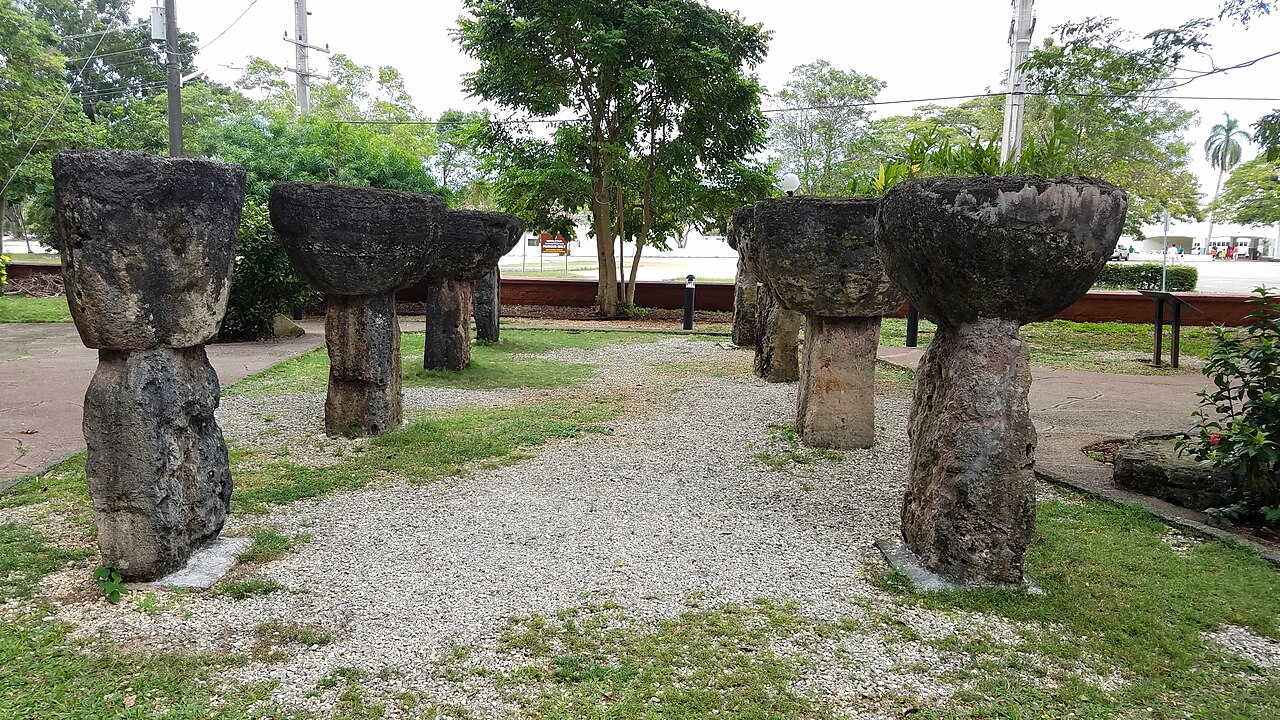
The Taotaomo'na: Guam's Jungle, Banyan Trees & Latte Stones ★ PREMIUM PIN
📍 Southern and central Guam jungle, latte sites island-wideThe word taotaomo'na means roughly "the people of before." In ancient Chamorro society these were not monsters. They were family. Households kept the skulls of their ancestors at home, offered them food and the best of the fishing catch, and asked them for help and protection. Remote ancestors, the ones beyond living memory, were reached through spirit counselors called makana, and later through suruhånu, the traditional healers who knew the island's medicinal plants. Then came Spanish colonization and the Catholic Church, and over the centuries the ancestors were recast as something to be feared. According to Guampedia, they became "pesky, troublesome and sometimes evil spirits."
That fear never fully displaced the respect, and it's why so many people on Guam still follow the old rule. The taotaomo'na live in the thick jungle, in caves, around latte sites, and especially in the great banyan trees (trongkon nunu). Before you walk into their land or take anything from it, you ask. The traditional words begin "Guella yan Guello, dispensa ham...": "Grandmother and grandfather, excuse us. May we walk through and visit your land." People who skip the courtesy tell of being pinched, bitten, or touched by something they can't see, and of waking up with unexplained bruises in yellow, brown, or purple. The spirits can appear as animals, as ordinary people, or without heads. Salt is said to weaken them. Asking nicely is said to work better.
Destination Truth S04 E08, "Guam Zombies / Fangalobolo" (2010)
Sixteen years before Expedition X, Josh Gates brought Destination Truth to Guam to investigate reported sightings of the taotaomo'na. The team started near the island's latte stones, the place where the spirits are most often said to appear, and went on to investigate the banyan trees they are believed to inhabit. The episode's "zombie" framing was a stretch, and it's generally regarded as an inaccurate portrayal of what the taotaomo'na are in Chamorro belief (ancestors, not the walking dead). The investigation itself, though, was one of the first times a major paranormal series took Guam's spirit tradition seriously on camera. The second half of the episode headed to Madagascar for the Fangalobolo.
This location is on the Phantom-Finder map as a Premium pin, one of the international locations the free Guam pin above is meant to give you a taste of.
★ Unlock This Pin with Premium
Manenggon Valley & the Southern Camps
📍 Manenggon Valley along the Ylig River, between Yona and Talo'fo'fo, GuamOn July 10, 1944, with the American fleet closing in, the Japanese commander ordered nearly the entire Chamorro population out of their villages and into camps in the island's southern interior. People walked from as far as Yigo in the north and Hågat in the west, infants to the elderly, carrying only what they could hold. The largest camp was Manenggon, a valley on both sides of the Ylig River, where as many as 18,000 people, roughly three quarters of the island's population, were held. Guampedia's account is blunt: "No buildings, latrines, food, or medicine were provided." Fires were banned so the smoke wouldn't give the camp away to American aircraft. People died of exhaustion, exposure, hunger, and disease, and no one kept count. Witnesses remember burials in and around the camp, but there are no records of how many.
Down the coast in Malesso' (Merizo), the last days of the occupation were worse. On July 15, 1944, Japanese soldiers killed 16 villagers at Tinta; 14 others were left for dead and survived. The next day, 30 men were taken to a place called Faha and killed. There were no survivors. American troops of the 77th Division reached Manenggon on July 30 and overran the main camps the next day, and Guampedia records that a planned machine-gun massacre there was prevented only by their sudden arrival. The island still gathers at Manenggon to remember the march. The valley itself is jungle again now, which is exactly the kind of place the island's ghost stories have always lived.

Yokoi's Cave, Talofofo
📍 Talofofo Falls park, Talo'fo'fo, GuamWhen Guam was declared secure in August 1944, it wasn't. Thousands of Japanese soldiers were still hiding in the jungle, and one of them, Sergeant Shoichi Yokoi, simply never came out. For nearly 28 years he lived in the Talofofo jungle in an underground shelter he dug and maintained himself, hunting at night and living on wild nuts, mangoes, papaya, shrimp, snails, frogs, and rats. He wove his clothes and bedding from native plants. On January 24, 1972, two local men, Manuel Tolentino De Gracia and Jesus Mantanona Dueñas, were checking their shrimp traps along the river when they came across him.
Yokoi went home to Japan a celebrity, and his first public words became a national catchphrase: "It is with much embarrassment that I return." His original cave was later destroyed by a typhoon, but a recreation stands at Talofofo Falls park. It isn't a ghost story. It's something stranger: proof that the war on Guam didn't end for everyone when the history books say it did, and that this jungle is deep enough to keep a man hidden for a generation. When people on Guam talk about figures glimpsed between the trees, this is the landscape they mean.
Guam Paranormal TV: Complete Episode Reference
-
Expedition X, "Ghosts of Guam"
S12 E04 · Discovery · September 9, 2026 · Hosts: Phil Torres & Heather Amaro · Locations: Asan Beach, WWII caves dug by Chamorro forced laborers, a freshwater river by boat, latte stones, and the deep jungle · Free pin -
Destination Truth, "Guam Zombies / Fangalobolo"
S04 E08 · Syfy · October 28, 2010 · Host: Josh Gates · Locations: Guam latte stone sites and banyan trees (taotaomo'na), plus Madagascar · Premium pin
Guam is free on the map. The rest of the world is waiting behind Premium.
Report compiled by Phantom-Finder Research Team • September 10, 2026 • Sources: Discovery, TVmaze, Wikipedia (Battle of Guam, Japanese occupation of Guam, Shoichi Yokoi, List of Destination Truth episodes), National Park Service (War in the Pacific National Historical Park), Guampedia, Guam Museum, The Guam Daily Post, Wikimedia Commons. Images via Wikimedia Commons (Public Domain / CC BY-SA).