Why Key West Is America's Southernmost Haunted City
Key West has no natural disasters to explain its paranormal density, no battlefields, no mass graves on the scale of Gettysburg or Savannah. What it has instead is centuries of isolation. Cut off from the mainland until 1912, this island absorbed wave after wave of wreckers, pirates, sailors, soldiers, and yellow fever victims, with nowhere for any of them to go. The dead here have had a very long time to settle in. Add one of the most infamous cursed objects in American history and a necrophilia case that reads like gothic horror fiction, and you have a paranormal ecosystem unlike anything else in the country. The spirits of Key West aren't just haunting buildings. They're haunting the whole island and they've clearly decided the weather is too good to leave.

Fort East Martello Museum & Robert the Doll
📍 3501 S. Roosevelt Blvd., Key West, FLFort East Martello is a Civil War-era brick citadel that never fired a shot in battle, it was still under construction when the war ended. What it became instead is the permanent home of Robert the Doll, a handmade Steiff toy from 1904 that has accumulated one of the most documented curse histories in American paranormal research. Robert was given to Robert Eugene Otto as a child in Key West. The boy spoke to the doll constantly, blamed it for household mischief, and reportedly the doll spoke back. Neighbors claimed to see the doll move between windows. Robert Eugene Otto kept the doll his entire life and left it to the house when he died. His widow, fearing it, eventually donated Robert to Fort East Martello, where it promptly began cursing visitors who didn't ask permission before photographing it.
The fort itself carries separate paranormal weight. Yellow fever soldiers, enslaved workers who died during construction, and the tortured energy of Elena Hoyos, whose story is inextricably linked to this building, contribute to what investigators describe as an oppressively heavy atmosphere, particularly in the lower chambers. The museum receives thousands of letters annually from visitors apologizing to Robert after experiencing streaks of bad luck following their visits. The doll is displayed behind glass. It doesn't always seem to be looking where it was last facing.
Deadly Possessions S01E01 — "Robert the Doll and The Dibbuk Box" (2016)
Zak Bagans launched his Deadly Possessions series, a show dedicated to cursed objects housed in his Las Vegas museum, with Robert the Doll as the debut episode, a choice that signals just how seriously the paranormal community takes this case. The episode featured victim testimony from individuals who photographed Robert without permission and experienced immediate, cascading misfortune: car accidents, job losses, relationship collapse, and illness. Zak examined the doll directly, reporting an overwhelming feeling of unease and documenting the doll's origins with the Steiff toy company in Germany. The episode established Robert the Doll as the anchor of Bagans' cursed object canon, and the museum subsequently saw a significant spike in apologetic letters sent to Robert by newly believing skeptics.
Shock Docs — "The Curse of Robert the Doll" (2022)
Six years after Deadly Possessions, Travel Channel and Discovery+ returned to Robert with a full Shock Docs documentary hosted by psychic medium Cindy Kaza. The film dug deeper into Robert's true origins, the theory that an enslaved Bahamian servant with knowledge of Juju or Voodoo practices crafted or cursed the doll in response to abuse by the Otto family. Kaza attempted direct contact with any entities attached to the doll and reported feeling extreme hostility emanating from the case. The documentary also traced the chain of custody from the Artist House (Otto's childhood home, now a B&B on Eaton Street) to Fort East Martello, documenting claims from Myrtle Reuter, the interim owner who reported the doll locked her in a room, before she donated it to the museum. The investigation concluded that the darkness attached to Robert is not residual, not a loop, it is active and aware.
📍 View on the Phantom-Finder Map
Captain Tony's Saloon
📍 428 Greene St., Key West, FLBefore it was a bar, 428 Greene Street was a lot of other things, none of them cheerful. Built in the mid-1800s as an icehouse (the only refrigeration on the island), it later served as the city morgue, the telegraph office, and finally a saloon. The building's most arresting feature is also its most haunted: a massive tree grows directly through the floor and out through the roof. That tree served as Key West's public gallows. Some locals claim as many as 17 people were hanged from it. You can drink a beer under it tonight.
The most documented spirit here is known as "Elvira", a woman convicted of murdering her husband and two children, who was hanged on the tree wearing a blue dress. Her gravestone is embedded in the concrete floor of the bar. When she was hanged, the dress turned blue-black from the trauma of death, and witnesses say she still appears in that same blue-black gown. The ladies' restroom reportedly has stall doors that lock and unlock on their own, a phenomenon that has been documented by multiple bartenders and patrons over decades and is attributed directly to Elvira. Ernest Hemingway drank here. Tennessee Williams drank here. Both men, notably, were drawn to stories darker than daylight, perhaps they sensed good company.
📍 View on the Phantom-Finder Map
Key West Cemetery & The Elena Hoyos Case
📍 701 Passover Ln., Key West, FL (Margaret & Angela St.)Key West Cemetery is 19 acres of above-ground vaults and weathered headstones sitting in the absolute geographic center of the city, because after the hurricane of 1846 washed the original coastal cemetery out to sea (coffins and all), the survivors decided to relocate their dead somewhere higher and harder to lose. The result is a burial ground that is both sprawling and surreal, known locally as the "Island of Bones." Its most famous epitaph reads: "I told you I was sick." Even the dead here have a sense of humor about their situation.
The cemetery's darkest connection, however, is Elena Hoyos. In the early 1930s, German-born radiologist Carl Tanzler became obsessed with Elena, a young Cuban woman he treated for tuberculosis at the U.S. Marine Hospital. When she died in 1931 at age 21, Tanzler paid for her elaborate mausoleum in Key West Cemetery, and then, two years later, stole her corpse. He kept Elena's body in his home for seven years, preserving it with chemicals, wiring the skeleton together with coat hangers, using glass eyes, and reportedly sleeping beside her. When discovered in 1940, Tanzler was briefly arrested but never convicted, the statute of limitations had expired. Elena's spirit is reported near her mausoleum to this day, described as a melancholy presence. Her story is one of the most genuinely disturbing true crime cases in Florida history, wrapped in the island's bone-dry sense that some things simply cannot be explained by any living person.
📍 View on the Phantom-Finder Map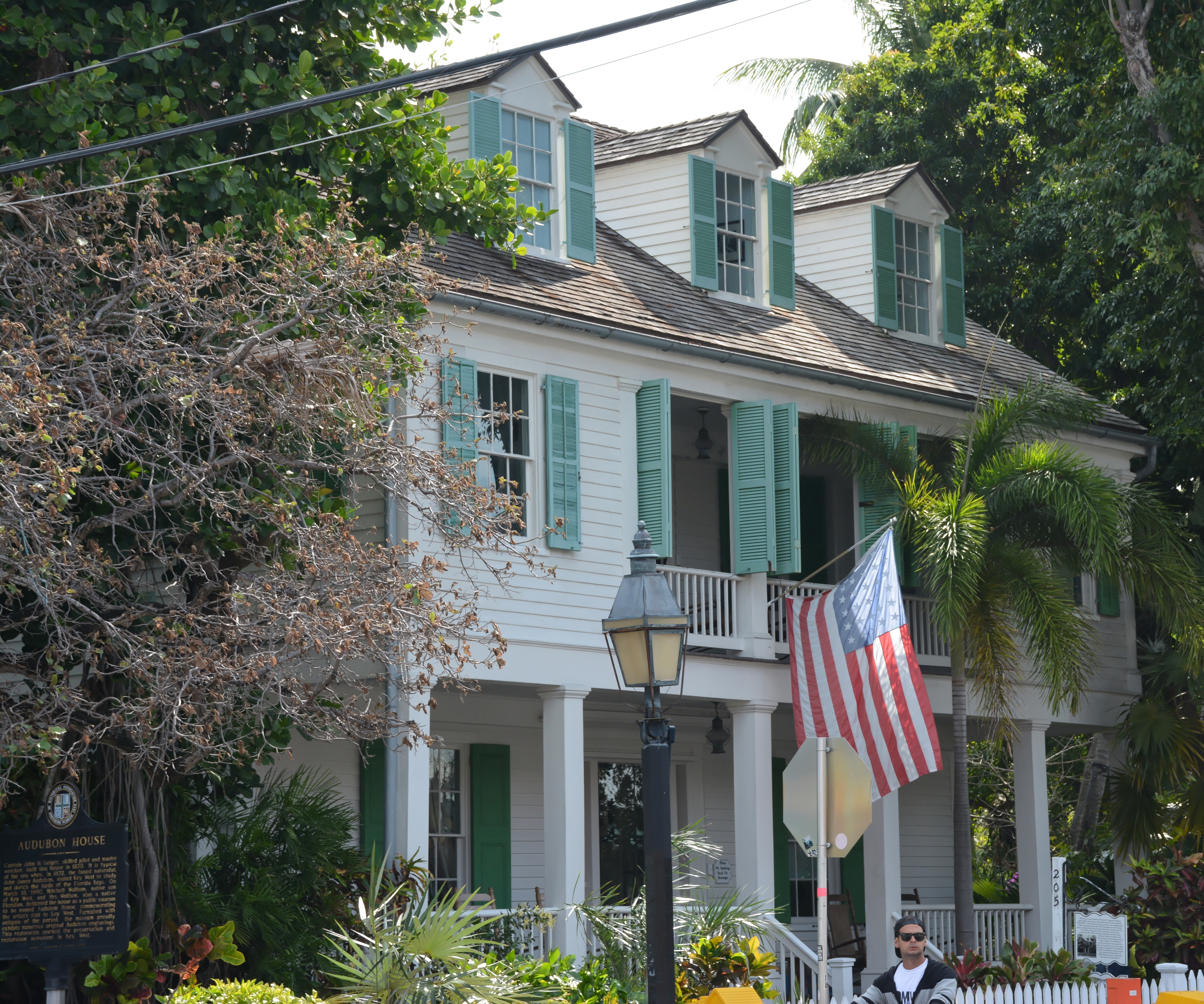
Audubon House & Tropical Gardens
📍 205 Whitehead St., Key West, FLBuilt between 1846 and 1850 by Captain John H. Geiger, harbor pilot, wrecker, and Key West's most successful salvage operator, the Audubon House is one of the oldest surviving structures in the city and the only building in Florida to receive an official haunted certification from two independent paranormal investigation organizations. It is not a gimmick. Both Messengers Paranormal and the CRIPT Seekers team conducted thorough EVP and thermal investigations and independently documented the same phenomena: children's voices and laughter captured on audio equipment, motion sensors triggering in empty rooms, and apparitions on the upper floors.
The primary spirits are members of the Geiger family. The children, who died in yellow fever epidemics that swept Key West repeatedly through the 19th century, are described as playful and non-threatening. Charles, the youngest, is specifically reported to tug at visitors' clothing. Captain Geiger himself has been spotted walking the tropical gardens at night in period dress. The third-floor presence, attributed to William Bradford Smith (the last surviving descendant who lived alone in the house for 25 years), is described as more somber and territorial. John James Audubon himself, the famous naturalist who painted Florida birds from this location, is reportedly seen on the entry porch and in the gift shop gallery, still studying his subjects, apparently, even from the other side.
📍 View on the Phantom-Finder Map
Ernest Hemingway Home & Museum
📍 907 Whitehead St., Key West, FLBuilt in 1851 in Spanish Colonial style and purchased by Ernest Hemingway and his wife Pauline in 1931, the Hemingway House is the most visited private historic home in Key West, and possibly the most famously self-haunted. Hemingway reportedly told friends during his lifetime that if there was an afterlife, he'd spend it in this house. He may have been more accurate than he intended. Hemingway died in 1961 in Ketchum, Idaho, but reports of his presence back in Key West began almost immediately afterward. A couple staying nearby in 1961 claimed to see a man matching his description wave at them from a veranda window, the same week of his death.
Tour guides report hearing typewriter sounds in the early morning hours coming from the studio above the carriage house, where Hemingway did his actual writing, waking before dawn and working until noon. His specter has been seen on the path between the main house and the studio, described as a large, bearded figure moving with purpose. Pauline Hemingway's spirit, she continued living in the house after their divorce and died in 1951, is most often reported at the top of the main staircase. The house's 50+ six-toed cats, descendants of Hemingway's own polydactyl pets, roam freely and have been observed by staff appearing to track movement in empty rooms, staring with focused intensity at nothing visible to human eyes. Animals, as any investigator will tell you, can be among the most reliable sensors.
📍 View on the Phantom-Finder Map
La Concha Hotel
📍 430 Duval St., Key West, FLWhen La Concha opened in 1926, it was the tallest building on Key West and the island's first luxury hotel. It served as U.S. Navy headquarters during the Cuban Missile Crisis in 1962, a detail that adds its own layer of Cold War dread to the building's already considerable paranormal portfolio. La Concha has documented 13 suicides since opening, plus multiple accidental deaths and at least one murder. The building welcomes paranormal investigators four to six times per year, which suggests management has made peace with its reputation.
The most persistently documented spirit is known as the Dead Waiter, a hotel employee who fell backward into an elevator shaft while on duty, his fall unwitnessed and his absence unreported for long enough to have consequences. His presence is concentrated around the elevator banks, and staff report hearing crying on the fifth floor with no traceable source. Ernest Hemingway was a regular at La Concha's rooftop bar, he reportedly always occupied the same room when staying, and has been seen in what is now called the "Hemingway suite" by guests who mistook him for a living person until he walked through a wall. Tennessee Williams, who lived in Key West for decades, also frequented the hotel and is rumored to linger here as well. Clearly the bar's last call has yet to come for some of its most devoted patrons.
📍 View on the Phantom-Finder Map
Fort Zachary Taylor State Park
📍 601 Howard England Way, Key West, FLFort Zachary Taylor was built between 1845 and 1866, held by Union forces throughout the Civil War, and never once fired its guns in anger. The enemy that killed people at Fort Zachary Taylor was not Confederate, it was yellow fever, tuberculosis, and diphtheria. Thousands of soldiers and laborers died at this installation from disease alone. No battles. No glory. Just slow, miserable death in the Florida heat, far from home, in a brick fort that held them until the end.
That kind of death leaves marks. Investigators and visitors report Civil War soldiers appearing in full uniform in the lower chambers, where the heat and lack of ventilation made disease deaths most concentrated. Sounds of mustering, footsteps in formation, a distant whistle, what may be the faint sound of gunfire from training exercises, are documented by multiple independent witnesses. Apparitions in blue Union uniforms have been seen from the fort's walls near dusk. The state park is open to visitors daily and includes Key West's best beach, which is a curious contrast: sun, sand, and snorkeling above, and something far less cheerful below in the old powder rooms. The spirits here seem to be doing what soldiers are conditioned to do: holding their post, waiting for orders that will never come.
📍 View on the Phantom-Finder Map
Key West Firehouse Museum (Fire Station No. 3)
📍 1024 Grinnell St., Key West, FLAmerica's Most Haunted Firehouse earns that title partly through genuine paranormal activity and partly through one of the most gloriously bizarre true crime stories in Florida history. Fire Chief Joseph "Bum" Farto served Key West from 1964 to 1976 in a style that can only be described as aggressively theatrical: flashy red suits, gold chains, rose-tinted glasses, and a lime-green car he called "El Jefe." Bum Farto was, by all accounts, a beloved local character and an effective fire chief. He was also, as it turned out, selling cocaine and marijuana from the firehouse.
Farto was arrested in February 1976 on federal drug trafficking charges, convicted, and faced 31 years in federal prison. He never reported for sentencing. Joseph "Bum" Farto vanished completely in 1976 and has never been found, not his body, not evidence of a new life elsewhere, nothing. The case remains officially unsolved. His spirit is reported throughout the firehouse, particularly near what is known as the "missing fire chief's desk," where paranormal investigation sessions attempt spirit box communication. A second entity named Frank, described as a full-bodied male apparition who appears so solid that visitors have attempted to speak with him before realizing he is not physically present, haunts the men's restroom. Glowing orbs, shadowy figures, and unexplained footsteps are documented by investigators who run regular VIP paranormal sessions at the museum. Bum Farto, it seems, finally found a way to avoid going to prison. He's just not going anywhere else either.
📍 View on the Phantom-Finder MapKey West Paranormal TV — Complete Episode Reference
-
Haunted History — "Haunted Key West"
S01 E09 · History Channel · October 21, 2000 · Locations: La Concha Hotel, Fort Zachary Taylor, Key West Cemetery, Audubon House, (former) Lopez Funeral Home / Elena Hoyos story -
Deadly Possessions — "Robert the Doll and the Dibbuk Box"
S01 E01 · Travel Channel · April 2, 2016 · Location: Fort East Martello Museum (Robert the Doll) -
Shock Docs — "The Curse of Robert the Doll"
Special · Travel Channel / Discovery+ · September 30, 2022 · Location: Fort East Martello Museum · Host: Cindy Kaza -
Paranormal Caught on Camera — "Robert the Doll and More"
S09 E05 · Travel Channel · 2025 · Hosts: Brian J. Cano & Sapphire Sandalo · Location: Fort East Martello Museum (Robert the Doll segment)
Report compiled by Phantom-Finder Research Team • April 17, 2026 • Sources: IMDB, TVmaze, Travel Channel, Discovery+, Haunted History (History Channel), Ghost Adventures Wiki, Robert the Doll Wikipedia, Wikimedia Commons. Images via Wikimedia Commons (Public Domain / CC BY-SA / CC BY 2.0).