How We Ranked the Ten Biggest UFO Cases in America
The United States has logged well over a hundred thousand UFO reports since the term entered public use in the 1940s, and the overwhelming majority are one person, alone, at night, with a light that moved strangely and nothing to show for it afterward. Those are not on this list. This one runs on physical debris, radar returns, multi-witness police involvement, official government investigation, cases that actually changed how the subject gets studied. Roswell sits at number one because the Army announced and then retracted a flying-disc recovery within twenty-four hours, a whiplash no explanation has fully closed. Socorro sits high because the witness was a trained police officer who left the encounter site with landing gear impressions in the dirt and burned brush. Portage County and Detroit made the list because it was law enforcement, or a government radar operator, who put the sighting on the record. If a case is here, something exists that outlived the witness telling the story.

Roswell, New Mexico — The 1947 Crash
📍 Foster homestead debris field, roughly 75 miles northwest of Roswell, Chaves/Lincoln County line, NMIn late June or early July 1947, rancher W.W. "Mac" Brazel found strange wreckage scattered across the property he tended outside Roswell, New Mexico: rubber, foil, sticks, and a tough paper-like material he could not identify. He reported it to the county sheriff, who called the Roswell Army Air Field. Major Jesse Marcel, an intelligence officer, drove out to look at it and came away convinced it was not a conventional aircraft or weather balloon. Base press officer Lieutenant Walter Haut wrote a press release stating plainly that the RAAF had recovered a "flying disc." The Roswell Daily Record ran it on July 8 under the headline "RAAF Captures Flying Saucer on Ranch in Roswell Region," and a regional ranch story became a national sensation overnight.
The reversal came just as fast. Within twenty-four hours, Army command in Fort Worth held a second press conference and announced the debris was nothing more than a weather balloon, with Marcel photographed in Fort Worth posing with balloon fragments for the cameras, alongside Brazel's own separate photographs taken back in Roswell. An official announcement of a flying disc, and an official retraction, from the same chain of command, twenty-four hours apart. In 1994, the Air Force released a report identifying the true source of the debris as Project Mogul, a classified program using high-altitude balloon trains fitted with sensitive microphones to detect Soviet nuclear detonations from a distance, secret enough in 1947 that a cover story was preferable to the truth. A follow-up 1997 report, "The Roswell Report: Case Closed," addressed the separate alien-bodies claims that had grown up around the case, attributing them to misremembered military tests using anthropomorphic crash-test dummies.
What keeps Roswell at number one is not the balloon explanation, which is well documented and generally accepted by researchers on all sides of the subject. It is the twenty-four-hour gap between "we have a flying disc" and "actually, never mind," a reversal so fast and so public that it became the founding template for every UFO cover-up story that followed. Roswell did not just produce a UFO case. It produced the modern vocabulary for distrusting the answer.
📍 View on the Phantom-Finder Map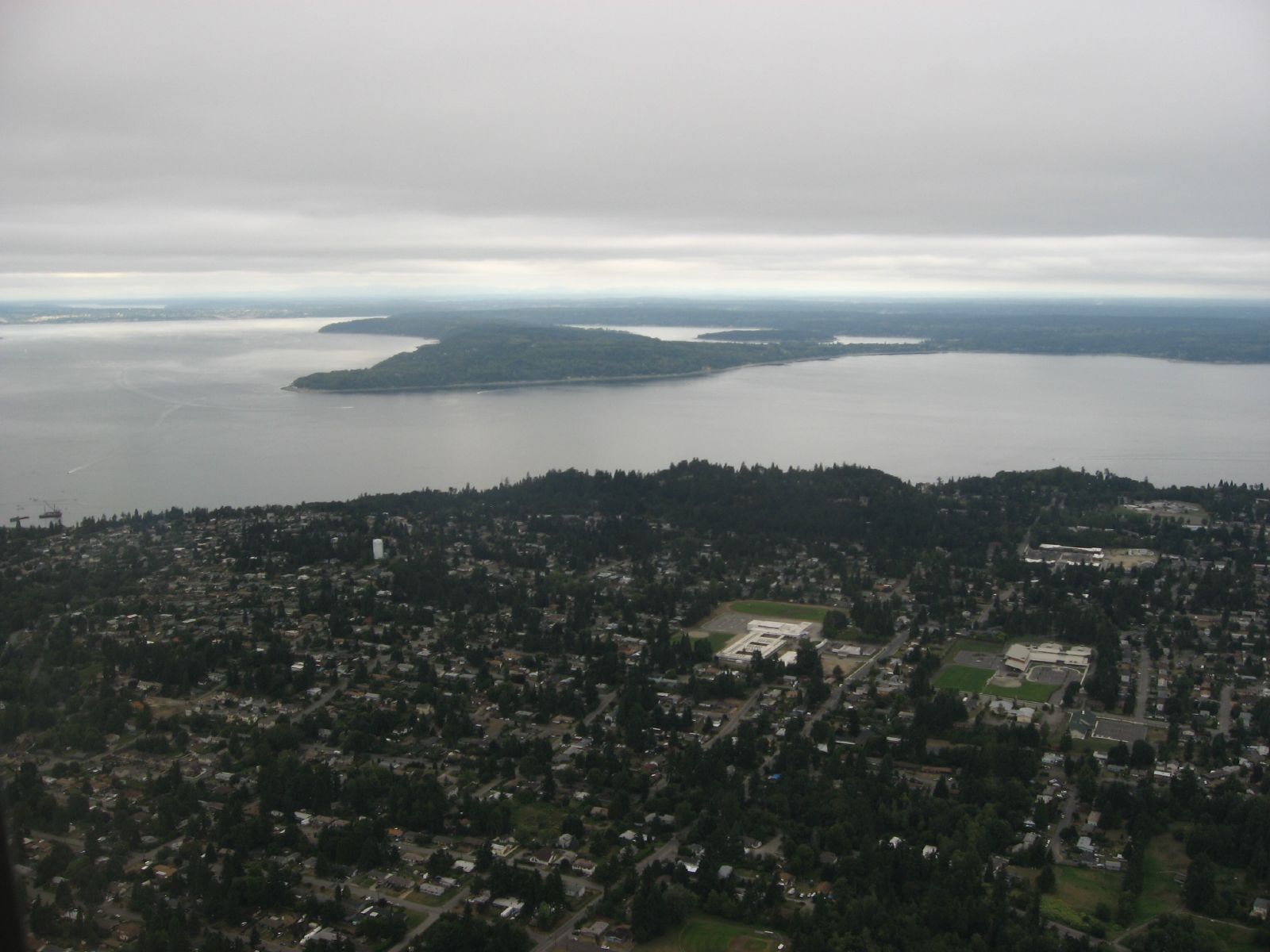
Maury Island, Washington — The Case Before Roswell
📍 Maury Island, Puget Sound, King County, WATwo weeks before the Roswell story broke in national headlines, harbor patrolman Harold Dahl said he watched six large, doughnut-shaped objects maneuvering low over Puget Sound near Maury Island on June 21, 1947. He said one of the six appeared to malfunction and expelled a shower of metallic, lava-like debris, some of which struck his boat, injured his son, and killed the family dog. His supervisor, Fred Crisman, said he recovered samples of the material afterward. Dahl later claimed a man in a dark suit visited him the next morning and warned him to stay quiet, one of the earliest documented "Men in Black" stories in American UFO lore, years before the phrase existed in pop culture.
A strange boat story is all this would be, except for what happened next. Two military intelligence officers, Captain William Davidson and Lieutenant Frank Brown, flew to Tacoma to collect the slag samples for analysis. On the return flight, their B-25 caught fire and crashed near Kelso, Washington on August 1, 1947, killing both men. A safe containing the alleged debris reportedly did not survive intact. The deaths, arriving barely a month after Roswell dominated headlines nationwide, cemented the case in early UFO research as either tragic coincidence or something far more troubling.
The case is now widely regarded, including by many researchers sympathetic to UFO phenomena, as a hoax perpetrated by Dahl and Crisman, con men with a taste for tall tales who probably never expected two men would die chasing their story. I'm not sure a hoax explanation gets to claim the whole case. It still predates Roswell, it still produced one of the first Men in Black accounts on record, and two Army officers are still dead in a B-25 outside Kelso no matter who started the story.
UFO Hunters — "The UFO Before Roswell" (2008)
The pilot episode of History's UFO Hunters opened the series with Maury Island specifically because it predates the case everyone already knew. The team worked Puget Sound and the Kelso crash site, interviewing researchers about the slag samples and the still-disputed circumstances of Davidson and Brown's deaths, framing the case as the true origin point of the modern flying saucer era.
📍 View on the Phantom-Finder Map
Socorro, New Mexico — The Lonnie Zamora Landing
📍 Landing site southwest of Socorro, near the New Mexico Institute of Mining and Technology, Socorro County, NMOn the afternoon of April 24, 1964, Socorro police officer Lonnie Zamora broke off a routine speeding pursuit when he heard a roar and saw a flame descending into a gully outside town, worried a dynamite shack had exploded. What he found instead, by his own sworn account, was a shiny, egg-shaped object resting on four extended landing legs, with two small figures in white coveralls standing near it. As Zamora approached on foot, the figures appeared to notice him, the object emitted a roaring blue-orange flame, and it lifted off and departed to the southwest.
Zamora radioed for backup immediately, and Sergeant Sam Chavez arrived within minutes to find him visibly shaken and struggling to describe what he had just seen. What the two officers found on the ground held up: four distinct rectangular landing-leg impressions pressed into the hardpan soil in a symmetrical pattern, along with several patches of scorched, still-smoldering brush consistent with the flame Zamora described. The insignia he sketched from memory, an arrow pointing up through a horizontal line into a half-circle, has never been definitively matched to any known aircraft, prank, or hoax device.
The case reached the White House level of attention. Dr. J. Allen Hynek, Project Blue Book's scientific consultant, personally investigated and could not explain it. Blue Book chief Hector Quintanilla later called it "the best-documented case on record" in an article he wrote for the CIA's own in-house journal, Studies in Intelligence. Blue Book's own final classification for Socorro is simply "unidentified," one of a small handful of cases the Air Force never closed with a conventional explanation. Zamora, a respected officer with no history of embellishment, never sought publicity from the encounter and stuck to his account for the rest of his life.
📍 View on the Phantom-Finder Map
Kecksburg, Pennsylvania — The Acorn Crash
📍 Kecksburg, Westmoreland County, PAOn the afternoon of December 9, 1965, a brilliant fireball crossed the sky over Michigan, Ontario, Ohio, Pennsylvania, West Virginia, and New York, visible to thousands of witnesses over roughly six states and a Canadian province. Most fireballs burn out. This one, according to residents of the small village of Kecksburg, Pennsylvania, came down slowly and under apparent control in the woods just outside town, rather than falling like a meteor. Kids who ran toward the smoke described a bell- or acorn-shaped object roughly the size of a Volkswagen Beetle, bronze or copper-colored, ringed near its base with markings that looked like hieroglyphics.
Within a short time, area residents say military personnel arrived, cordoned off the woods, and searched through the night with the local fire department's help. Multiple witnesses, including volunteer firefighters who were on scene, later said they saw a flatbed truck leave the area carrying a large object under tarps. The official Air Force position, issued the next day, was that nothing had been recovered because there was nothing there to recover, attributing the fireball itself to a meteor. Eyewitnesses describing a search and a truck; an official record showing neither. Honestly, that gap is the whole case, and forty years of records requests haven't closed it.
NASA spent decades saying it had no records, until a 2003 Freedom of Information Act lawsuit filed by journalist Leslie Kean and backed by the Sci-Fi Channel forced a court-monitored search, completed in 2009, for boxes of records once believed lost. NASA had already stated in 2005 that fragments examined decades earlier had been identified as debris from a Soviet satellite, though the supporting paperwork itself had gone missing sometime in the 1980s. The most-cited conventional theory holds the object was Kosmos 96, a Soviet Venus probe that failed to leave Earth orbit and reentered around that date, though the reentry timeline is disputed by researchers who have tracked it. The village leans into the mystery today: Kecksburg's volunteer fire department has a life-size acorn replica on display, and the case is still nicknamed "Pennsylvania's Roswell."
📍 View on the Phantom-Finder Map
Portage County, Ohio — The 86-Mile Police Chase
📍 Portage County to Conway, Pennsylvania (chase route along I-76/PA border), Ravenna, OHIn the early hours of April 17, 1966, Portage County sheriff's deputies Dale Spaur and Wilbur "Barney" Neff spotted what Spaur described as an object shaped "like an ice cream cone tipped over on its side," with a pointed protrusion trailing off the rear and a sound like an overloaded transformer, and gave chase, covering roughly 86 miles at speeds between 80 and 105 mph, crossing from Portage County into Pennsylvania, with the object at times appearing to slow down and wait for the patrol car to catch up before accelerating away again.
The chase ended in Conway, Pennsylvania, where Spaur and Neff were joined by East Palestine patrolman Frank Panzanella, who watched the object alongside them before it shot straight up and vanished. Panzanella radioed a Rochester, Pennsylvania radio dispatcher, who called Greater Pittsburgh Airport and reported the object was showing up on their radar, though the Air Force and FAA later denied any unusual radar contact that night. Multiple police officers across two states and a civilian dispatcher had now all independently corroborated part of the same event on the same night.
The Air Force's official explanation, delivered by Blue Book chief Major Hector Quintanilla, was that the deputies had first chased the Echo satellite passing overhead and then the planet Venus, unusually bright and low on the horizon that night. Portage County Sheriff Ross Dustman said publicly that he did not believe it and stood by his deputies. The case's aftermath was hard on Spaur personally: he reported a second sighting weeks later, lost weight, began disappearing for days, and eventually left both his job and his marriage. Steven Spielberg has cited the case's police-radio chatter and pursuit structure as an inspiration for the climactic highway chase sequence in "Close Encounters of the Third Kind."
📍 View on the Phantom-Finder Map
Dexter, Michigan — The Swamp Gas Incident
📍 Frank Mannor farm and marshland, Dexter, Washtenaw County, MIOn the night of March 20, 1966, farmer Frank Mannor and his son reported a glowing object descending into the marsh behind their property near Dexter, Michigan. Local police, sheriff's deputies, and dozens of civilians converged on the swamp and reported watching lights maneuvering low over the ground for hours. The following night, roughly fifty miles away, students and staff at Hillsdale College, along with a local civil defense director, reported a separate but strikingly similar glowing object over the campus arboretum. Between the two nights, more than a hundred people had gone on record.
Michigan Congressman Gerald R. Ford, then House Minority Leader and later President, publicly demanded a congressional review of how the Air Force was handling UFO reports, giving the case a political weight most sightings never receive. The Air Force sent Dr. J. Allen Hynek, Project Blue Book's civilian scientific consultant, to investigate. At a March 25 press conference in Detroit, packed with reporters and furious witnesses, Hynek offered a tentative theory that decaying vegetation releasing methane, so-called "swamp gas," could account for some of the lights witnesses described in the marsh. The press ran with "swamp gas" as the whole explanation, and the phrase became a national punchline aimed squarely at the Air Force's credibility.
Hynek never claimed swamp gas explained everything reported over the two nights, and he said so at the time, but the nuance didn't survive the headlines. Thirty years later, Washtenaw County's sheriff at the time, Douglas Harvey, told a reporter that Hynek privately admitted he didn't actually know what the witnesses had seen. The public ridicule that followed the swamp gas explanation is widely credited as the turning point that pushed Hynek away from Air Force debunking and toward becoming one of the most respected serious UFO researchers of the twentieth century, eventually founding the Center for UFO Studies.
📍 View on the Phantom-Finder Map
West Michigan — The 1994 Lakeshore UFO Event
📍 Ottawa, Muskegon & Allegan Counties along the Lake Michigan shoreline, MIOn the night of March 8, 1994, residents across Ottawa, Muskegon, and Allegan counties in West Michigan began calling 911 to report clusters of lights, five or six objects arranged like a strange flickering string of Christmas lights in blue, red, white, and green, moving over Lake Michigan and the surrounding towns of Holland, Zeeland, and Muskegon. Local police units were dispatched and independently corroborated what callers were describing, radioing in their own observations of lights performing sudden direction changes that didn't match any conventional aircraft.
A Holland police officer, Jeff Velthouse, called the National Weather Service radar station at Muskegon County Airport directly and described what he was seeing over the phone while it was still happening, which is the part that separates this from a lights-in-the-sky story. Over the following days and weeks, MUFON and independent investigators logged more than three hundred separate witness accounts from the region, an unusually large number for a single-night event confined to one metropolitan corridor.
Radar operator Jack Bushong pulled up his scope while Velthouse was still on the line and found three, sometimes four, distinct blips moving over the lake that weren't registering as aircraft. He described the movement afterward about as plainly as a government radar operator ever has on the record: they weren't planes, and they jumped position and altitude in a way nothing he'd tracked before ever had.
📍 View on the Phantom-Finder Map
Skinwalker Ranch, Utah — The Most Studied Property on Earth
📍 Private ranch near Ballard, Uintah County, UT (bordering Ute Indian Reservation)The Ute Tribe has held that the land bordering this 512-acre ranch in the Uintah Basin sits on the path of the skinwalker, a malevolent shapeshifting figure in Navajo tradition, and Ute members have long been discouraged from going near it. The Myers family ranched the property quietly from 1905 to 1987 with no publicized incidents, and then Terry and Gwen Sherman bought it in 1994 and everything about the place changed. The Shermans reported cattle found dead with surgical precision, circular burn patterns in the fields, large animals that vanished and reappeared without tracks, and repeated encounters with hovering orbs of light, documented later in the bestselling book "Hunt for the Skinwalker."
In 1996, Las Vegas billionaire Robert Bigelow, who built his fortune in extended-stay hotels before founding Bigelow Aerospace, bought the ranch from the exhausted Shermans for roughly $200,000 and began funding formal scientific study through his National Institute for Discovery Science. That research effort eventually evolved into Bigelow Aerospace Advanced Space Studies, which later held a Pentagon contract connected to the government's Advanced Aerospace Weapon System Applications Program, tying a private Utah cattle ranch directly to a federal UFO research effort that only became public knowledge in 2017.
Since 2020, The Secret of Skinwalker Ranch has followed a team that includes former defense and aerospace personnel using military-grade sensors, magnetometers, and drones to systematically map the property. The show has repeatedly featured team members with backgrounds in skepticism describing readings and events they say they cannot explain through conventional means. I still don't know what I think the ranch actually is, a hoax that got away from everybody or a real hotspot nobody's cracked, and thirty years of researchers with real credentials haven't settled it either. What's not in dispute is the paper trail: local ranchers, a billionaire's private institute, and a Pentagon-linked research program, all pointed at the same 512 acres.
📍 View on the Phantom-Finder Map
Devils Tower, Wyoming — The Landmark That Became a Symbol
📍 Devils Tower National Monument, Crook County, WYDevils Tower is a nearly 1,300-foot volcanic butte rising abruptly out of the Wyoming plains, sacred to the Lakota, Cheyenne, Kiowa, and other Plains tribes for centuries under names that translate to Bear Lodge, long before it carried any connection to UFO lore. It became America's first National Monument in 1906 under Theodore Roosevelt, and its striking, almost artificial-looking geology, hexagonal columns rising in near-perfect symmetry, has made it a magnet for stories about things that don't belong in an ordinary landscape.
The tower's connection to UFO culture is largely modern and largely cinematic: Steven Spielberg chose it as the site of first contact in 1977's "Close Encounters of the Third Kind," filming the climactic sequence at its base and turning the formation into visual shorthand for peaceful alien arrival across the world. That fame folded back into the region's own reporting history. Northeastern Wyoming, including the country around the tower, has a long-standing pattern of unexplained aerial light reports independent of the film, feeding a persistent local belief that Spielberg picked the location because something about the area was already considered strange.
There's no single incident anchoring Devils Tower's spot on this list, and I'll admit that makes it the odd one out here. Stand at the base of those columns at dusk and look straight up 1,300 feet of basalt that looks machined rather than grown, in a spot Plains tribes were calling Bear Lodge for a thousand years before a Hollywood crew ever showed up with a mothership prop, and the reason it belongs on this list stops needing an argument. Half a million people climb up to it every year, and most of them have no idea why the rock feels so familiar.
📍 View on the Phantom-Finder Map
Aurora, Texas — The 1897 Airship Mystery
📍 Aurora Cemetery, Aurora, Wise County, TXIn the middle of a nationwide wave of "mystery airship" reports that swept American newspapers that spring, an airship allegedly crashed in Aurora, Texas on April 17, 1897, and two days later a story datelined Aurora ran in the April 19 edition of the Dallas Morning News under local correspondent S.E. Haydon's byline. Haydon wrote that a cigar-shaped airship had come in low over town, clipped Judge J.S. Proctor's windmill, and exploded, scattering wreckage across the property. The pilot's body, badly disfigured, was recovered and, Haydon wrote, was "not of this world." Papers covered in unreadable hieroglyphic writing were reportedly found on the body, and the remains were said to have been buried in the town cemetery.
I went back and forth on whether Aurora belongs on this list at all. It is, by the account of nearly every researcher who has since examined it, almost certainly a hoax, and not even a subtle one: no period record confirms Judge Proctor ever owned a windmill, and no burial record for a mystery pilot has ever surfaced in the cemetery's own books. It stays on the list for the timing, not the evidence: fifty years before Roswell, a small-town reporter had already reached for "not of this world" and hieroglyphic writing and a body pulled from wreckage, the exact vocabulary the genre would run on for the next century. The Texas Historical Commission has since put up an official marker at the cemetery, and MUFON crews swept the grounds with metal detectors in the 1970s and 80s and found nothing.
Aurora's own long-serving local historian, Etta Pegues, put it best decades later: Haydon "wrote it as a joke and to bring interest to Aurora," a small town whose fortunes were fading after being bypassed by the railroad and could use a good story. He had, by her account, a well-earned local reputation for tall tales.
📍 View on the Phantom-Finder MapUFOs on Television — Complete Episode Reference
-
Unsolved Mysteries — "The Roswell UFO Incident"
S5 E4 · Netflix · 2024 · Location: Roswell, New Mexico -
UFO Hunters — "The Real Roswell"
S2 E5 · History · 2008 · Location: Roswell, New Mexico -
Ancient Aliens — "The Relics of Roswell"
S15 E2 · History · 2020 · Location: Roswell, New Mexico -
Expedition Unknown: Hunt for Extraterrestrials — "Roswell Revealed"
S1 E4 · Travel Channel · 2017 · Location: Roswell, New Mexico -
UFO Hunters — "The UFO Before Roswell"
S01 E01 · History Channel · 2008 · Location: Maury Island, Washington -
Expedition X — "UFOs Over New Mexico"
S3 E3 · Discovery Channel · 2021 · Location: Socorro, New Mexico -
UFO Files — "Kecksburg UFO"
S2 E4 · History · 2005 · Location: Kecksburg, Pennsylvania -
UFO Hunters — "Cops vs. UFOs"
S02 E09 · History · 2008 · Location: Portage County, Ohio -
Hangar 1: The UFO Files — "Cops and UFOs"
S02 E05 · History · 2015 · Location: Portage County, Ohio -
Sightings — "Portage County UFO"
S03 E19 · Fox · 1994 · Location: Portage County, Ohio -
Unsolved Mysteries — "Something in the Sky"
S03 E02 · Netflix · 2022 · Location: West Michigan (1994 lakeshore event) -
The Secret of Skinwalker Ranch — "Digging Deeper"
S01 E01 · History Channel · 2020 · Location: Skinwalker Ranch, Utah -
Ancient Aliens — "The Mystery of Skinwalker Ranch"
S15 E10 · History Channel · 2020 · Location: Skinwalker Ranch, Utah -
Expedition X — "Skinwalker Valley" / "Valley of UFOs"
S06 E07 & E08 · Discovery · 2023 · Location: Uintah Basin, Utah -
The UnXplained — "Mystery of Devil's Tower"
S1 E4 · History · 2019 · Location: Devils Tower, Wyoming -
UFO Hunters — "First Contact"
S2 E4 · History · 2008 · Location: Aurora, Texas
Report compiled by Phantom-Finder Research Team • September 4, 2026 • Sources: IMDB, TVmaze, History Channel, Discovery Channel, Netflix, Travel Channel, Fox, Roswell Daily Record archives (July 1947), declassified USAF reports on Project Mogul (1994/1997), Project Blue Book case files, National Weather Service Muskegon radar records, Wise County/Aurora Texas Historical Commission records, J. Allen Hynek's Center for UFO Studies archives, "Hunt for the Skinwalker" (Kelleher & Knapp), Wikipedia, Wikimedia Commons. Images via Wikimedia Commons (Public Domain / CC0 / CC BY 2.0 / CC BY-SA 2.0 / CC BY-SA 3.0 / CC BY-SA 4.0).